
The C-Brace: a leg brace that thinks with every step.
For people living with leg weakness or partial paralysis, the C-Brace by Ottobock does what a locked brace never could — it reads your movement in real time and lets you walk on stairs, slopes, and uneven ground, with support that catches you if you stumble.
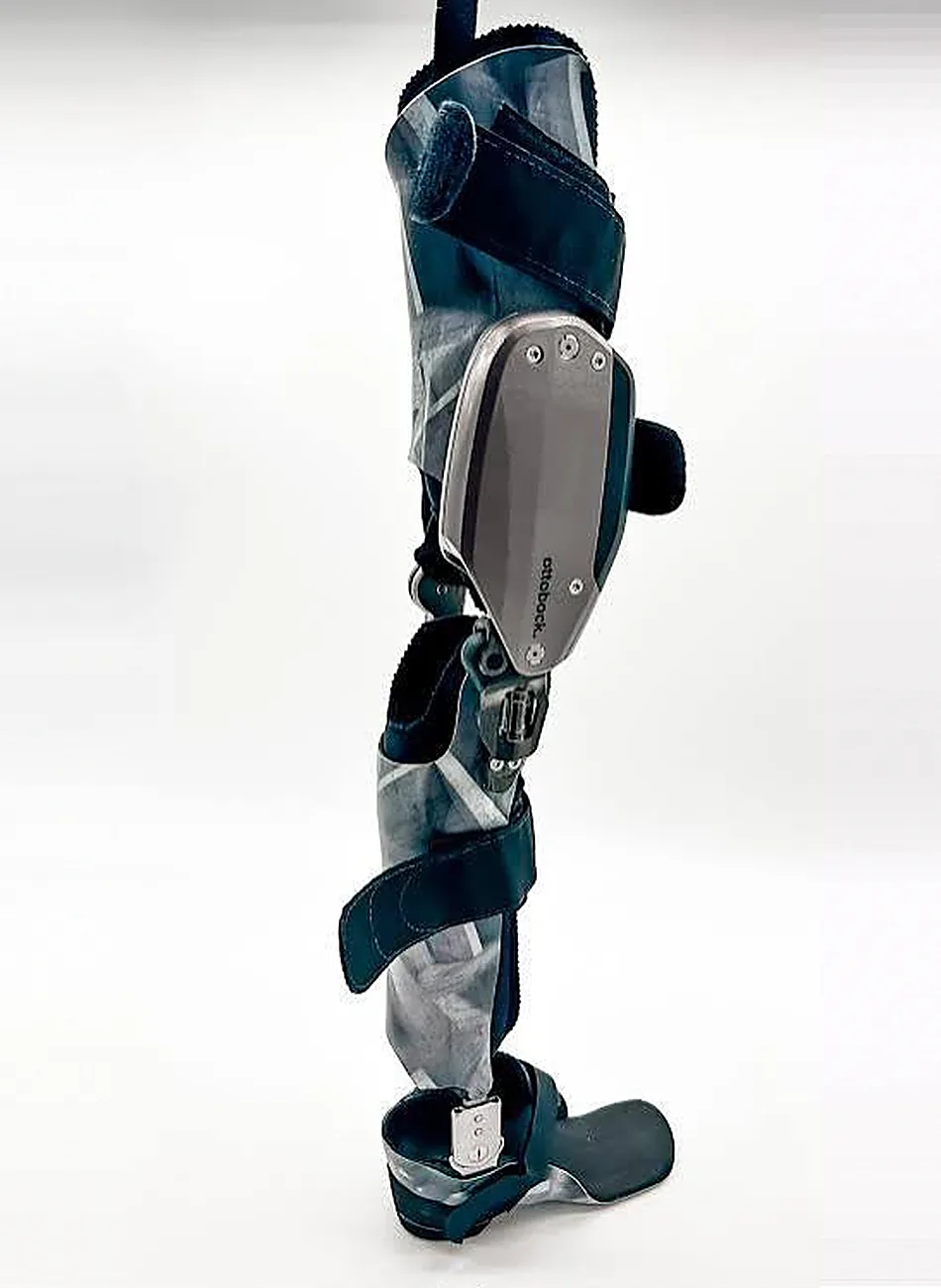
Not a locked knee. A smart one.
A traditional knee-ankle-foot orthosis (KAFO) gives you one choice: a knee locked straight, or one that swings free. The C-Brace is the first orthosis to control both the stance and the swing phase of your gait with a microprocessor. Sensors track your knee angle and motion continuously, and a hydraulic knee adjusts its resistance instantly — firm when you bear weight, released for a natural bend as you step.
- Walk at whatever speed feels natural, not one rigid pace.
- Take stairs and ramps step over step, instead of one leg at a time.
- Bend the braced leg under load to sit down normally.
- Cross grass, gravel, and uneven sidewalks with support that adapts.
- Recover from a trip — stumble detection holds the knee so you can catch yourself.
And it's designed to fit into your day, not dominate it:
- Low-profile enough to wear discreetly under your clothes.
- Light enough that walking takes noticeably less effort.
- Adjustable from a companion smartphone app — including a dedicated cycling mode.

People we see benefit most.
The C-Brace is designed for neurological leg weakness. The strongest candidates generally have intact hip and gluteal strength, with weakness or partial paralysis below that level. Leading indications include:
- Incomplete paraplegia (typically with little to no spasticity).
- Post-polio syndrome.
- Incomplete spinal cord injury and certain peripheral nerve injuries.
- Some neuromuscular conditions, and stroke-related weakness when spasticity is mild and hip strength is sufficient.
Only a hands-on evaluation can tell whether the C-Brace is right for you — which is exactly what a free consultation is for. We evaluate C-Brace candidates at all six of our clinics: Justice (Chicago), Tinley Park, Rockford, Munster, Las Vegas, and Henderson.
What the research shows.
The C-Brace is one of the most-studied advanced orthoses available. In published research comparing it with conventional braces, users saw meaningful gains in safety, walking, and confidence:
fewer falls on average than with conventional braces, in a 2023 randomized trial of 102 people.[1]
average falls in the previous six months, before fitting and again at one year, in a registry of 48 patients.[2]
walking speed and improved balance confidence, both statistically significant.[2]
- Ruetz A, DiBello T, Toelle C, et al. A microprocessor stance and swing control orthosis improves balance, risk of falling, mobility, function, and quality of life of individuals dependent on a knee-ankle-foot orthosis for ambulation. Disability and Rehabilitation. 2023;46(17):4019–4032. doi:10.1080/09638288.2023.2258342
- Lundstrom RL, Klenow TD, Morris A, et al. The C-Brace microprocessor controlled stance and swing orthosis improves safety, mobility, and quality of life at one year: interim results from a prospective registry. Journal of Rehabilitation and Assistive Technologies Engineering. 2024;11:20556683241269539. doi:10.1177/20556683241269539
Try it before you commit.
You don’t have to take this on faith. Before a custom C-Brace is ever made, we can fit a trial orthosis so you can feel how it walks — on real stairs, real slopes, in real life. If it works for you, we capture the measurements and casting for a device built entirely around your body, then pair it with a rehabilitation plan so the technology turns into daily function.
Like any powered device, it’s charged and maintained, and there’s a learning curve as you build trust in the dynamic knee. Our role is to be honest about the trade-offs — for some people a traditional KAFO, a different orthosis, or focused therapy is the better fit, and we’ll tell you that. When the C-Brace is right, the difference can be remarkable. Compare the C-Brace with Agilik and NEURO HiTronic →
We’ll verify your coverage first.
The C-Brace is billed under Medicare code L2006, the code for microprocessor-controlled knee-ankle-foot orthoses, and is covered under the Medicare leg-brace benefit when it’s medically necessary and prescribed — typically with you responsible for 20% after your Part B deductible. Some commercial plans still review it case by case, so before anything is built we verify your benefits, document medical necessity, and explain any out-of-pocket cost up front — no surprises.