
Lower-limb prosthetics
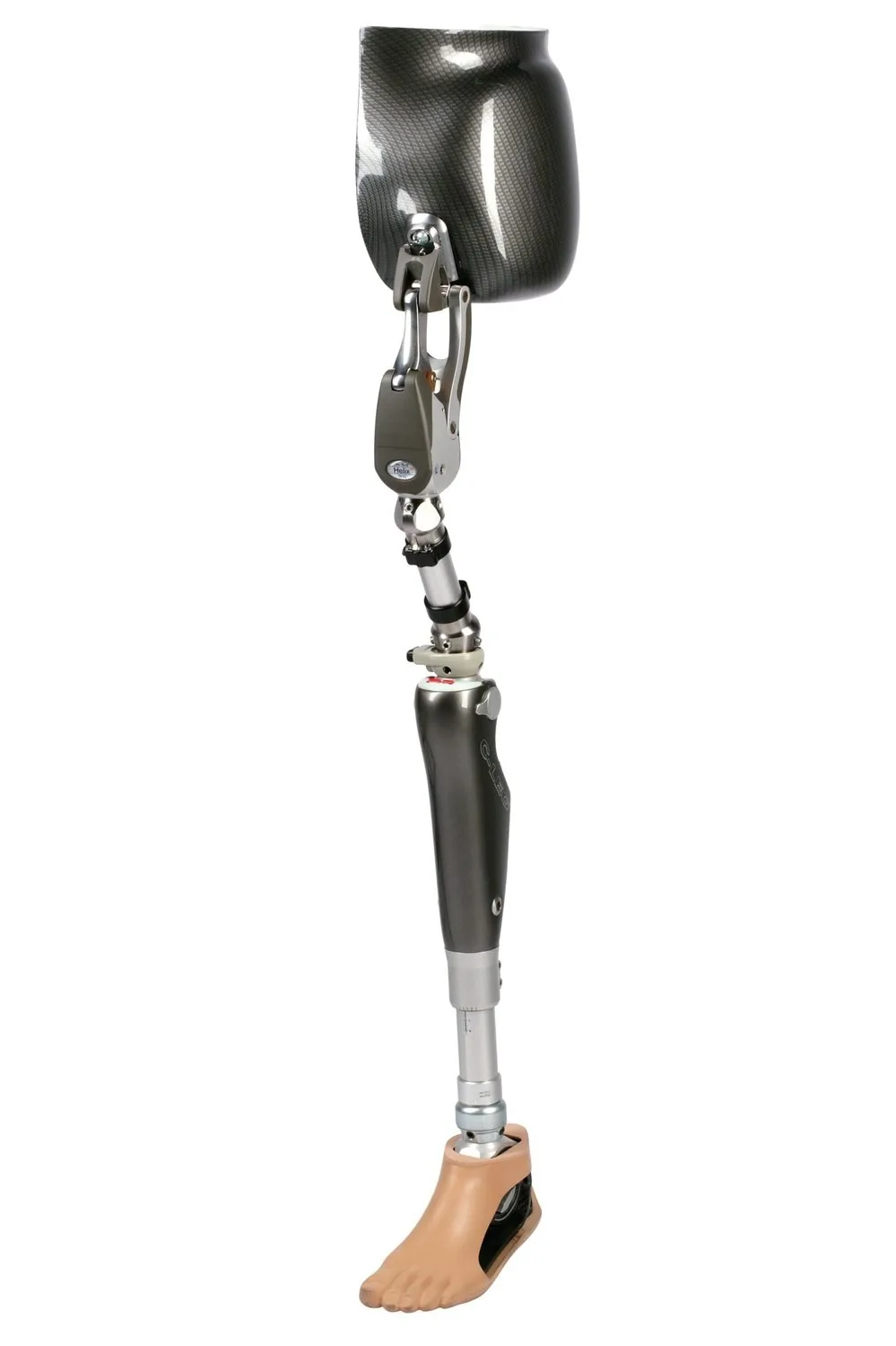
Prosthetic legs for above-knee and below-knee amputees — custom sockets, microprocessor knees, prosthetic feet, and partial-foot prostheses.
What care here looks like.
Most people come to us at one of three moments: they've just had an amputation and nobody has told them what happens next; they've worn the same leg for years and it's stopped fitting; or someone has told them their goals aren't realistic and they don't believe it.
All three are worth a conversation. The first one is more urgent than people realize — what happens in the first few months shapes how well you walk for years afterward.
We fit every lower-limb level, from partial foot through hip disarticulation, across six clinics in Illinois, Indiana and Nevada.
- Comfortable custom sockets, including expedited and adjustable-fit programs (RevoFit and Infinite Socket) so you're not waiting months in a socket that hurts. Caring for your prosthetic liner and socket →
- Microprocessor knees that read your stride and adapt to stairs, slopes, and changes in speed in real time. C-Leg vs Genium: choosing a microprocessor knee →
- Microprocessor and energy-storing ankle-foot systems for everyday walking, work, and sport.
- Partial-foot and Syme prostheses, plus solutions for new, long-time, and revision amputations. A new amputee’s guide to the first year →
Prosthetic feet and ankles
The foot is the part of a prosthetic leg you notice least and depend on most. It absorbs impact at heel strike, carries you through mid-stance, and returns energy at toe-off. Get it wrong and everything above it — knee, socket, your back — compensates.
Energy-storing (dynamic response) feet
Carbon fiber keels that compress under load and spring back as you push off. The returned energy makes walking less tiring and is the standard choice for anyone walking community distances. Stiffness is matched to your weight and activity level — too stiff and it fights you, too soft and it feels unstable.
Microprocessor and powered ankles
Sensors read each step and adjust ankle angle in real time. On a slope or stairs, the ankle repositions so your foot stays flat rather than forcing you to accommodate. For people who walk on uneven ground, work on ladders or ramps, or have balance concerns, the difference is substantial. These are heavier, need charging, and cost considerably more — coverage depends on documented functional level.
Multiaxial and shock-absorbing feet
Where energy-storing feet flex mainly front-to-back, multiaxial feet also move side to side, which helps on grass, gravel and uneven terrain. Shock-absorbing pylons reduce impact through the socket for heavier users and higher-impact activity.
Waterproof and activity-specific feet
Swimming, showering, beach and boat use need a foot and often a whole limb built for water. Running blades, cycling feet and high-heel-adjustable ankles each do one job. A second activity-specific limb is often covered when medical necessity is documented properly — ask us before assuming it isn't.
Choosing a foot is a fitting question, not a catalog question. We trial.
Prosthetic knees
Microprocessor knees (MPKs)
A microprocessor knee reads your stride dozens of times per second and adjusts hydraulic resistance to match. Going down stairs or a ramp, it resists so your knee doesn't buckle. Changing pace, it keeps up. The main clinical benefit is stumble recovery — the knee recognizes an unexpected flexion and resists rather than collapsing, which is why MPKs are associated with lower fall rates in appropriate users.
They need charging, they're heavier, and they cost more. Insurance ties them to documented functional level.
C-Leg vs Genium: choosing a microprocessor knee →
Mechanical knees
Single-axis, polycentric and weight-activated stance-control designs. Lighter, simpler, no charging, easier and cheaper to service, and genuinely the better choice for some people — particularly limited-community walkers and anyone who needs a limb that tolerates water, dust and neglect.
Sockets — the part that decides everything
You can put the best knee and foot in the world under a socket that doesn't fit and the limb will sit in a closet. Almost every "my prosthesis doesn't work" conversation we have turns out to be a socket conversation.
Fit changes, especially early. Your residual limb loses volume for months after surgery. A socket that fit in week six will be loose by week sixteen. That's expected, it's managed with sock ply and liner changes, and eventually with a new socket — it isn't a sign anything went wrong.
Suspension matters as much as shape. Suction, elevated vacuum, pin-lock and sleeve suspension each suit different limbs, activity levels and skin conditions. Elevated vacuum in particular can help with volume fluctuation and skin integrity.
3D-printed and digitally designed sockets. We use digital scanning and additive manufacturing where it produces a better result — faster iteration on test sockets, and geometry that's difficult to achieve by hand. It is a fabrication method, not a magic one: the clinical judgment about shape and load distribution is still what determines fit.
Care by amputation level
Partial foot and Syme
Preserves the most function and is often fitted poorly because it looks simple. Load distribution and toe-off mechanics are genuinely difficult at this level.
Partial foot amputation prosthetics →
Transtibial (below knee)
The most commonly fitted level. Your own knee is intact, which means better energy efficiency and more natural gait than any above-knee setup can achieve. Socket comfort and foot selection carry most of the outcome here.
Transfemoral (above knee)
The prosthesis has to supply knee function, which changes everything — gait training is longer, energy cost of walking is higher, and socket fit at the ischium and soft tissue is more demanding. This is where microprocessor knees earn their cost for most users.
Above-knee amputation recovery →
Knee disarticulation, hip disarticulation and hemipelvectomy
Less common, more complex, and the levels where experience matters most. Component selection is constrained and socket design carries unusual loads.
Bilateral amputation
Fitting two limbs is not fitting one limb twice. Height, balance, and the sequence of learning to stand and walk all need planning. Many bilateral users benefit from starting at a reduced height and progressing.
The first year, realistically
Weeks 0–6, healing. Compression to manage swelling and shape the limb. No prosthesis yet.
Weeks 4–8, first prosthesis. Once the surgical site has healed and swelling settles, we fit a temporary (preparatory) prosthesis, coordinated with your surgeon. This is not your final leg and it isn't meant to be.
Months 2–6, learning and change. Gait training, and frequent adjustment as your limb changes volume. Socket replacements in this window are normal.
Months 6–12, definitive fitting. Once your limb has stabilized, we build the socket and component set you'll live with — informed by everything we learned about how you actually walk.
Timelines vary with healing, comorbidities and activity goals. Anyone who gives you a fixed schedule before examining you is guessing.
Cost, insurance and K-levels
Medicare, Medicaid in Illinois, Indiana and Nevada, and most commercial plans cover medically necessary prostheses with a physician's prescription. Componentry is tied to your K-level — Medicare's functional classification, K1 through K4, describing your potential to ambulate:
- K1 — transfers and household walking at fixed cadence
- K2 — limited community walking, able to negotiate low obstacles like curbs and stairs
- K3 — community walking at variable cadence, able to traverse most environmental barriers; microprocessor knees are typically approved from K3, and may also be covered at K2 when additional documented Medicare criteria are met
- K4 — activity exceeding basic ambulation, including impact and athletic demand
K-level is assigned from documented clinical assessment of your potential, not just your current function — which is why the documentation matters and why people are sometimes assigned lower than they should be. We document this carefully, and if we think your assignment understates you, we'll say so and support the case.
People we help most.
- Recent amputees taking their first steps — often before a permanent socket is even possible. Above-knee amputation recovery →
- Long-time wearers whose current socket has stopped fitting or started to hurt. How long does a prosthetic leg last? →
- Anyone told their goals 'aren't realistic' who wants an honest second opinion. Troubleshooting common prosthetic problems →
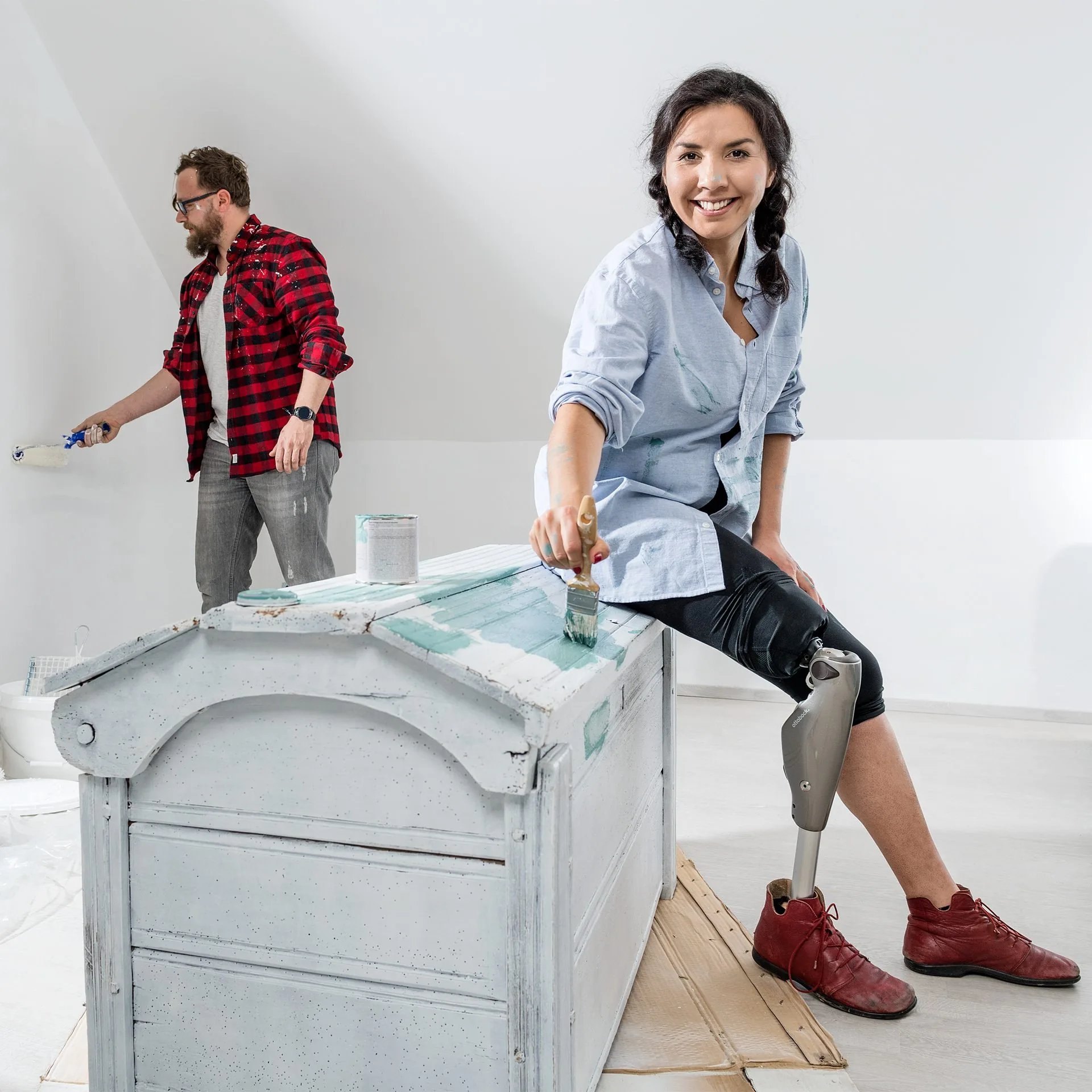
Care that earns the comparison.
- A free consultation, always — no referral needed to talk.
- Comfort-first sockets and fittings: we treat comfort as the whole point, not a luxury.
- The newest technology, available now, through our dedicated trial clinics.
- Six clinics across Illinois, Indiana, and Nevada — with a team that stays beside you after the fitting.
Next step
Talk it through, free.
A consultation costs nothing and answers most questions in one visit — coverage included. No referral needed.
Book a free consultationCall now