
How Much Does a Prosthetic Leg Cost — and What Does Insurance Actually Cover?
It’s usually the first question after an amputation, and it’s the one the internet answers worst. You’ll find numbers from $5,000 to $150,000 presented with no context, and almost nothing about the part that actually determines what you pay: how insurance decides what you qualify for.
We fit prosthetic legs every day and handle the insurance work behind them. Here’s the honest version.
The short answer on price
A prosthetic leg is not one product — it’s a custom-fabricated socket plus components (knee, foot, pylon, liner, suspension) selected for your amputation level and activity. Broad, real-world ranges:
| Type of leg | Typical device range |
|---|---|
| Below-knee (transtibial) | ~$8,000 – $25,000+ |
| Above-knee (transfemoral) | ~$20,000 – $60,000+ |
| Microprocessor knee (component alone) | ~$25,000 – $75,000+ |
| Specialty / activity-specific (running, waterproof) | Outside these ranges |
Important: these figures describe the device and fitting, not your out-of-pocket cost. Most patients do not pay anything close to list price, because most prosthetic care in the U.S. runs through insurance.
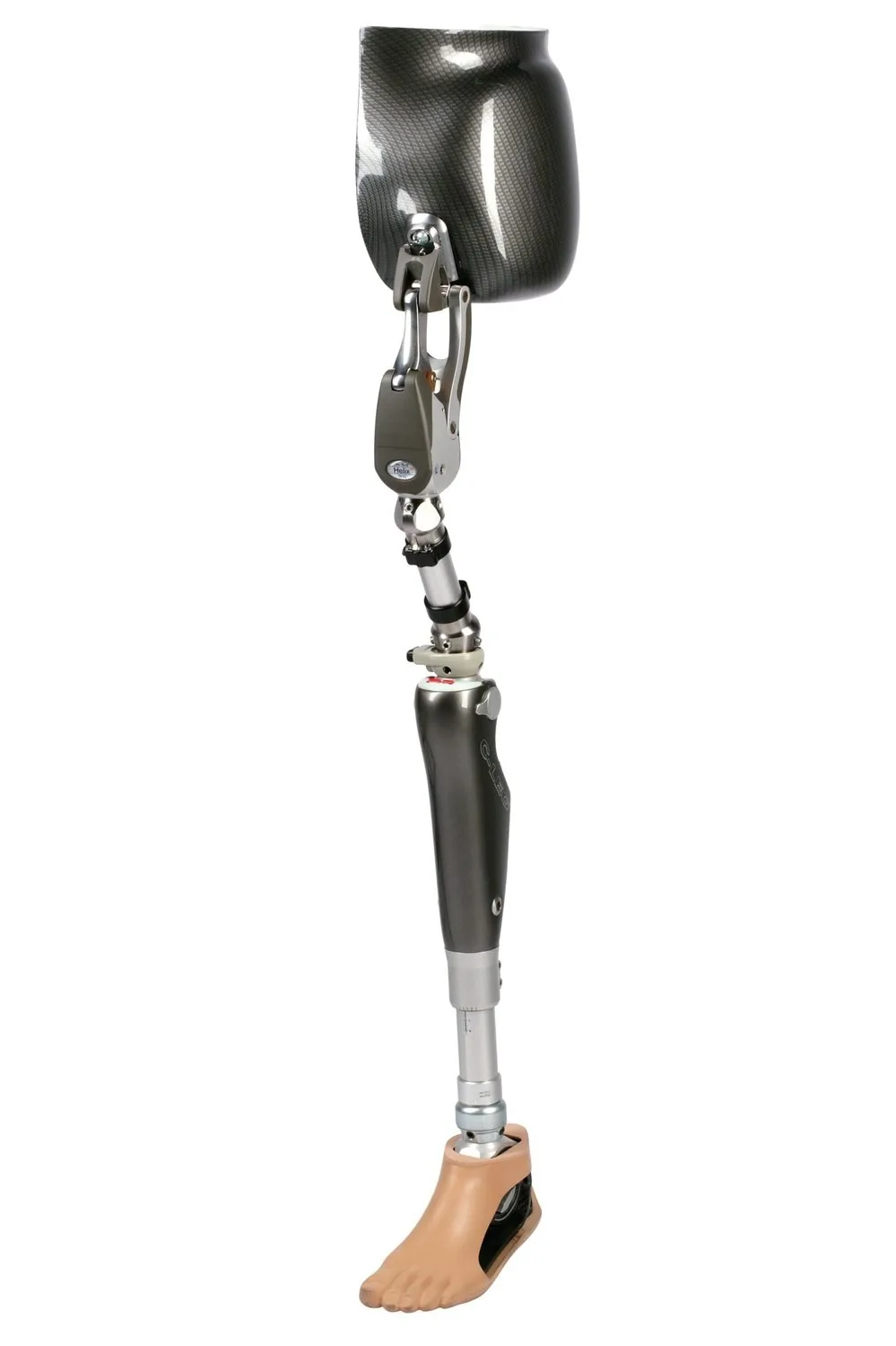
What decides what insurance covers: your K-level
For Medicare — and most private insurers follow Medicare’s framework — coverage hinges on your functional level, called a K-level: K0 (not a prosthetic candidate), K1 (household walker), K2 (limited community walker), K3 (community walker at a variable pace), and K4 (high-activity). Your K-level determines which components you’re eligible for — microprocessor knees, for example, are covered from K2 through K4, with additional documented criteria at K2.[1]
We’ve written a full guide to K-levels and how to appeal your classification — read it here.
How Medicare pays
Medicare Part B covers prosthetic limbs when prescribed by your physician and provided by an enrolled supplier, paying 80% of its approved amount after your deductible — the remaining 20% coinsurance is where supplemental (Medigap) plans usually come in. For the full breakdown of the 80/20 split, prior authorization, and appeals, see how Medicare covers prosthetics.
Private insurance and Medicaid
Most commercial plans cover prosthetics, with the variables being your deductible, coinsurance, out-of-pocket maximum, and whether the plan imposes device caps. State Medicaid programs cover prosthetics with state-specific rules — Illinois, Indiana, and Nevada each handle this differently, which is exactly the kind of detail we verify for you before anything is ordered.
What the process looks like (and who does the paperwork)
- Prescription from your physician
- Evaluation with a prosthetist — amputation level, limb condition, goals, K-level documentation
- Verification & prior authorization — we confirm your specific benefits and submit the clinical justification. This is our job, not yours.
- Fabrication & fitting — custom socket, component assembly, alignment
- Follow-up — sockets are refined as your limb changes, especially in the first year
You should know your out-of-pocket number before fabrication starts. If a provider can’t tell you that, ask why.
Does insurance cover replacements and repairs?
Yes, within reason. Sockets are typically replaceable when your limb changes enough that fit is compromised (common in the first 12–18 months post-amputation), and components have expected service lives — see how long a prosthetic leg lasts. Insurers cover medically necessary replacements with documentation — another paperwork burden that belongs to your provider, not you. Newer fabrication methods can shift the math too; read how 3D-printed sockets and prosthetics fit in.
What if I’m denied?
Denials happen, and they are frequently overturned on appeal with stronger documentation. Prior authorization pushback is a normal part of this field, and a practice that fits advanced components should be experienced at writing the clinical justification that wins appeals. We are, and we don’t charge you to fight for your own coverage.
The bottom line
The sticker price of a prosthetic leg tells you almost nothing about what you’ll pay. What matters is your K-level, your specific plan, and whether your provider does the verification and authorization work up front — all knowable before you commit to anything.
Start with a free consultation — bring your insurance card, and we’ll tell you what your plan covers and what your realistic out-of-pocket looks like. Book here or call any of our six clinics across Illinois, Indiana, and Nevada.
Written by Vikram Choudhary, CPO/LPO. This article is educational; coverage details depend on your individual plan and clinical presentation.
Sources
- Centers for Medicare & Medicaid Services. Local Coverage Determination L33787: Lower Limb Prostheses (revision effective September 1, 2024). cms.gov