
C-Leg vs Genium: choosing a microprocessor knee
For an above-knee (transfemoral) amputation, a microprocessor knee (MPK) uses sensors and software to read your movement many times a second and adjust resistance automatically — making stairs, ramps, and uneven ground safer and walking less tiring. Two of the most widely fitted MPKs are Ottobock’s C-Leg and Genium. They share a heritage, but they aren’t the same tool. Here’s how they differ — and, more importantly, how to think about which is right for you.
The short version
| C-Leg | Genium | |
|---|---|---|
| Introduced | 1997 (the original MPK) | 2011 |
| Sensing | Knee angle & load sensors | Adds gyroscope + accelerometer |
| Gait feel | Stable, well-proven | More natural; optimized physiological gait |
| Stairs | Step-over-step descent; step-to ascent | Step-over-step descent and ascent |
| Water | Weatherproof (rain/splashes) | Genium: fresh-water resistant (IP67); Genium X3/X4: fully waterproof (IP68) |
| Battery | About 2 days | ~5 days typical |
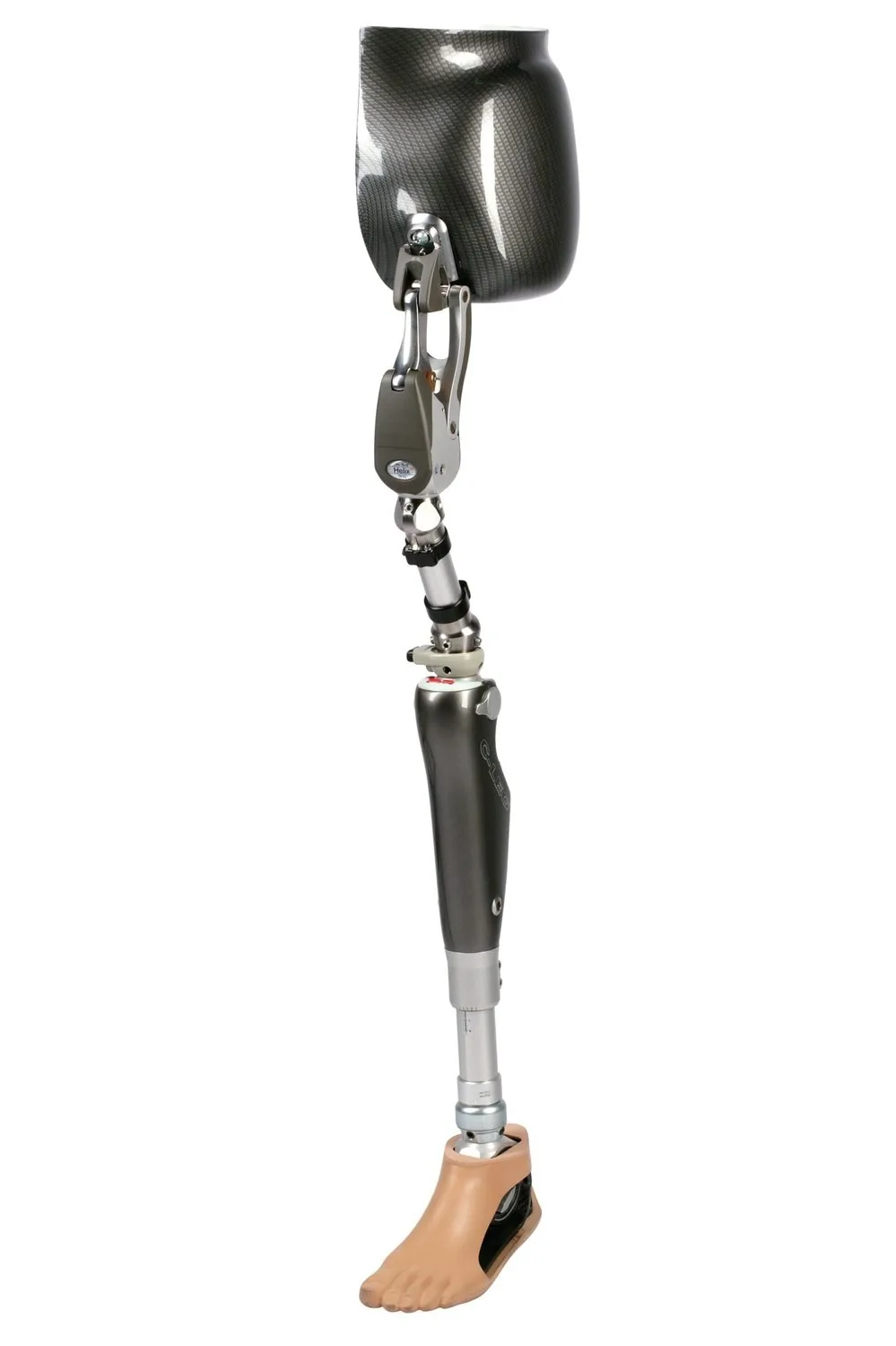
C-Leg: the proven standard
The C-Leg was the world’s first fully microprocessor-controlled knee and remains the most-studied MPK, with a long clinical track record for reducing falls and increasing walking confidence. Its hydraulic system controls both stance and swing, an intuitive stance function helps it stay stable when you stop on a slope, and the current generation pairs with a phone app to switch modes and check battery. For many people, the C-Leg is exactly the right amount of technology: dependable, lighter on the wallet than the top tier, and extremely well understood by clinicians and insurers.
Genium: closer to natural gait
The Genium builds on that foundation with more sensors (including a gyroscope and accelerometer) and faster, richer processing, which it uses to reproduce a more physiological gait. Practically, that translates to features the C-Leg doesn’t offer: walking up stairs step-over-step, stepping over obstacles, a pre-flexed stance that softens heel strike, and dedicated stance functions useful for standing and for bilateral users. The waterproof Genium X3/X4 variants extend this to swimming and showering. The trade-off is cost — the Genium sits well above the C-Leg, and the waterproof models higher still. Whichever knee you choose, it works as a system with the foot beneath it — see our guide to prosthetic feet and ankles.
So which one?
The honest answer is that the “better” knee is the one matched to your life, and that match is a clinical decision, not a spec-sheet contest. A few questions that usually decide it:
- How varied is your daily terrain? Lots of stairs, slopes, and obstacles favor the Genium’s features.
- How active are you? Your Medicare/insurer K-level helps determine which devices are justified and covered.
- Is water exposure a real part of your life or work? That points toward a waterproof Genium variant.
- What will your plan approve? High-end MPKs typically need prior authorization.
Both knees are excellent; this isn’t a case of old versus new. Plenty of active people are best served by a C-Leg. The right call comes from a gait evaluation with your prosthetist.
At Quantum we fit and service both. If you’d like a hands-on evaluation — including what your insurance is likely to cover — book a free consultation and we’ll work it through with you. Lower-limb prosthetics →