Myoelectric arm prosthesis: how it works and who qualifies
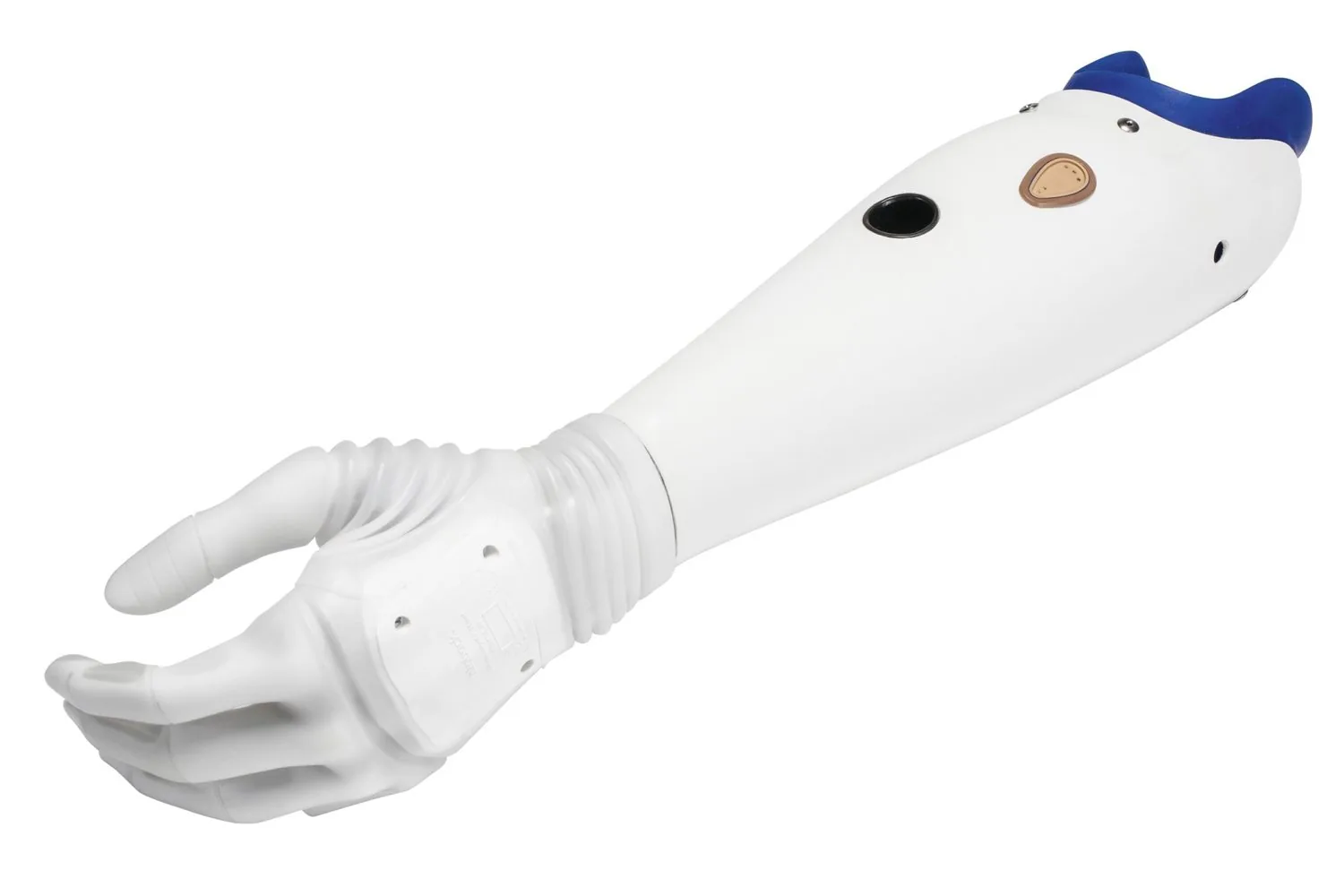
A myoelectric arm prosthesis turns the small electrical signals your muscles already produce into motion. When you contract a muscle in your residual limb, sensors inside the socket pick up that signal and tell a motor to open a hand, rotate a wrist, or bend an elbow. There is no harness pulling on your shoulders and no cable to operate — the limb responds to the same intention to move that you have always had.
If you are weighing your options for an upper-limb prosthesis, this guide explains how myoelectric control works, what the system is made of, who tends to do well with it, and what the fitting and training process actually looks like.
The short version
Myoelectric arms are powered, intuitive, and can move remarkably like a natural limb. They are also more complex, heavier, and more sensitive to moisture than a body-powered prosthesis, and they are not automatically the right answer for everyone. The best choice depends on your goals, your daily activities, the level of your limb difference, and the quality of the muscle signals available to drive the device. A hands-on evaluation is the only way to know for certain.
How myoelectric control works
Every time a muscle contracts it generates a faint electrical signal. A myoelectric prosthesis reads those signals through surface electrodes that sit against the skin inside the socket — a technique called electromyography, or EMG. The electrodes detect the signal, a small onboard controller interprets it, and a battery-powered motor carries out the movement.
The most common setup uses two control sites: one muscle group to open the hand and another to close it. How hard or how quickly you contract can also control grip speed and strength in many systems. For higher-level limb differences, or where clean signals are harder to find, more advanced strategies are available.
What the system is made of
A myoelectric arm is built from a few cooperating parts:
- Terminal device — the hand or gripper, ranging from a powered single-grip hand to a multi-articulating hand with individually driven fingers that can form many grip patterns.
- Wrist — may allow powered or manual rotation and, in some designs, flexion, so the hand can be positioned for tasks like eating or typing.
- Elbow — for above-elbow (transhumeral) limb differences, a powered or mechanical elbow restores reach.
- Socket and electrodes — the custom interface that holds the limb securely, distributes pressure comfortably, and places the electrodes where your signals are strongest.
- Battery and controller — the rechargeable power source and the electronics that translate your muscle signals into movement.
Single-grip, multi-articulating, and pattern recognition
Not every myoelectric hand is the same. A single-grip hand opens and closes in one motion and is durable and straightforward. A multi-articulating hand can change grip patterns — a pinch for a key, a wider grasp for a bottle, a point for a touchscreen — usually selected through a sequence of muscle signals, a button, or a phone app.
Pattern-recognition systems take this further. Several electrodes read the overall pattern of your muscle activity, and software learns to associate specific patterns with specific movements, which can make control feel more natural. For people with higher amputations, a surgical technique called targeted muscle reinnervation (TMR) can create stronger, more distinct signals for the prosthesis to read. Whether any of these is right for you is part of the conversation during your evaluation. If part of the hand remains, our guide to partial-hand amputation options covers a distinct category with its own solutions.
Who is a good candidate?
Myoelectric prostheses tend to suit people who want a natural-looking limb, value intuitive control, and do not routinely expose the device to heavy impact, grit, or water. A successful fit usually depends on healthy skin, a residual limb that can produce usable muscle signals, and the time and motivation to learn a new way of moving.
They are not the only good option. Body-powered prostheses are lighter, extremely durable, give a degree of physical feedback through the cable, and stand up better to demanding work or wet environments. Many people use more than one device for different parts of their life. The honest answer to “which is best” is the one that fits your actual days — which is exactly what an evaluation is for. If your arm is weakened but intact — after a stroke or nerve injury — a powered orthosis like the MyoPro brace may fit better than a prosthesis.
What fitting and training involve
The process is collaborative and unfolds over several visits:
- Evaluation — we discuss your goals and map where your muscle signals are strongest.
- Casting or scanning — we capture the shape of your limb to build a precise socket.
- Diagnostic fitting — a trial socket lets us confirm comfort, electrode placement, and control before the definitive build.
- Training — often alongside an occupational therapist, you practice isolating signals and using the device for real tasks. Skill builds with repetition, and most people improve steadily over the first weeks and months.
- Follow-up — adjustments keep the fit comfortable and the control dialed in as you adapt.
Caring for a myoelectric arm
Because the system is electronic, a little routine care goes a long way. Keep the socket and electrode contacts clean and dry, charge the battery as directed, and avoid submerging the device unless it is specifically rated for moisture — most are not. Periodic maintenance keeps the motors and electronics working reliably, much like servicing any precision equipment.
What about cost and insurance?
Myoelectric arms — especially multi-articulating hands — are among the more advanced prosthetic options, and coverage varies by plan and by documented medical need. Rather than quote a figure that may not apply to you, we walk through your specific benefits with you. You can read more on our cost & insurance page, and our guide to whether Medicare covers prosthetics explains the documentation that supports a claim.
Questions about your own situation? A free consult is the fastest answer
Every limb, every goal, and every set of muscle signals is different. The most reliable way to know whether a myoelectric arm is right for you is a hands-on evaluation. Learn more about our upper-limb prosthetics and prosthetic technology, or book a free consultation and we will talk it through.